
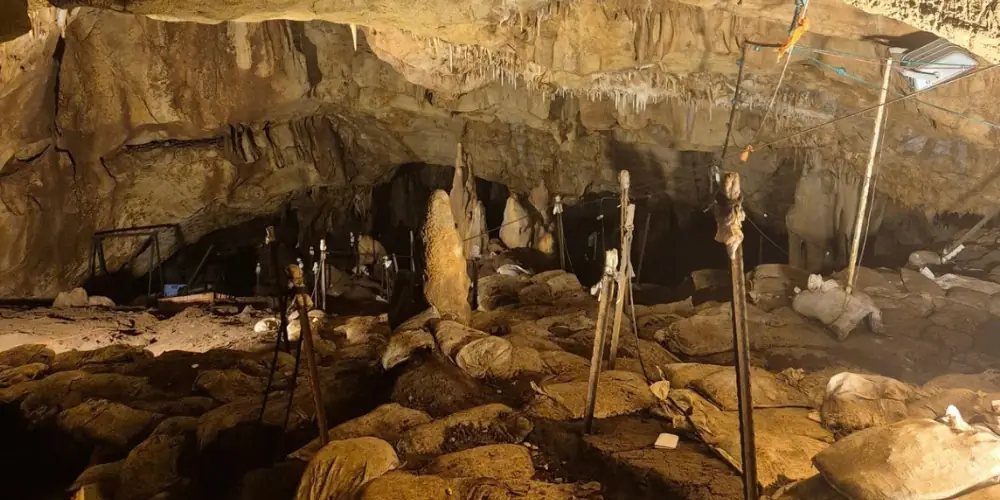
Roughly 100,000 years ago, a cave in the Levant became home to an unexpected social experiment. Evidence from Tinshemet Cave shows that early modern humans and Neanderthals were not simply crossing paths—they were living, learning, and adapting together.
The discoveries challenge long-held assumptions about separation between species and point to a shared way of life built on cooperation, skill, and common rituals.
This site reveals a striking idea: survival mattered more than biological differences. Daily life, from hunting to burial practices, followed the same cultural pattern across groups that were once thought to be distinct.
A Single Cultural System
Archaeological research continues to reshape how Neanderthals are understood. They were not primitive or lacking intelligence. They crafted refined tools, adjusted to harsh climates, and likely practiced symbolic behaviors. Interaction with Homo sapiens, including interbreeding, is already well documented.
Tinshemet Cave adds a deeper layer to this understanding.
Fossil evidence shows that Homo sapiens and Neanderthal-like populations lived in the same region during a shared timeframe, estimated between 130,000 and 80,000 years ago. Dating methods confirm this overlap consistently. Biochronology strengthens the timeline, with species like Mastomys and Arvicanthis—tropical rodents—serving as environmental markers for that period.
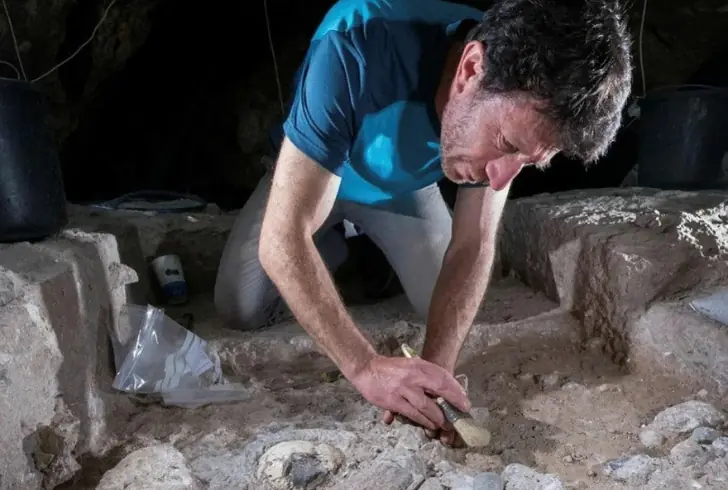
Yet the real surprise lies in the tools.
Stone tools often act as cultural signatures. Specific designs usually point to specific groups. At Tinshemet, that pattern breaks down. Despite the presence of different human species, the tools found are identical in design and technique.
Shared Technology and Hunting Practices
The dominant method at the site is the centripetal Levallois technique. This approach involves shaping a flint core in a controlled way to produce a planned flake. It requires precision, foresight, and practice.
This is not a simple or accidental method. It depends on knowledge passed from one individual to another, likely through teaching. The same technique appears at other nearby sites such as Qafzeh, Skhul, and Nesher Ramla. This consistency suggests that groups across the region were connected, exchanging ideas and maintaining similar practices.
Tool design also offers clues about hunting behavior.
The people of Tinshemet Cave focused on large animals like aurochs—massive wild cattle—and equids such as wild horses. These were not easy targets. Hunting them required planning, coordination, and teamwork. Unlike earlier populations that hunted opportunistically, this group showed a clear preference for high-risk, high-reward prey.
Such hunts could not be done alone. They demanded cooperation among skilled individuals. Fossil and tool evidence strongly indicate that these hunting groups included both Homo sapiens and Neanderthals working side by side.
Rituals That Reflect Shared Beliefs
Cultural connection becomes even clearer through burial practices.
Excavations uncovered five individuals, including two well-preserved skeletons: an adult known as Tinshemet 2 and a child referred to as Tinshemet 1. Both were buried in the same position—lying on their right side in a fetal posture, with arms drawn toward the face.
This positioning was deliberate. It reflects a structured ritual rather than random placement.
The site also yielded more than 7,500 fragments of ochre, a natural pigment made from iron-rich materials. The shades range from yellow to deep red. Analysis shows that this ochre was transported from sources up to 100 kilometers away, indicating intentional collection and use.
Some of the pieces appear to have been heat-treated, most likely to deepen their color. In one burial, researchers found a large chunk of red ochre placed carefully between the legs of the deceased. The placement feels deliberate rather than random, suggesting symbolic meaning—possibly tied to ideas about life, death, or personal identity.
The use of ochre and similar burial styles have been identified at nearby sites such as Qafzeh Cave and Skhul Cave. The fact that these practices appear across multiple locations suggests a shared system of meaning. When different groups follow the same burial customs, it signals a broader cultural connection rather than isolated traditions.
A Connected Human Story
Discoveries at Tinshemet Cave challenge the long-standing view that Homo sapiens developed independently while other human species faded away. Instead, the evidence points to overlapping populations that exchanged tools, knowledge, and behaviors.
Neanderthals, in this context, do not appear separate or inferior. They were part of a broader human story shaped by interaction and adaptation. Tinshemet represents a place where this exchange influenced daily life.
The longevity of this shared culture—around 50,000 years—suggests it was both stable and successful.
Genetic evidence strengthens this interpretation, with Neanderthal DNA in modern humans pointing to direct contact.
Ongoing Research and Key Questions
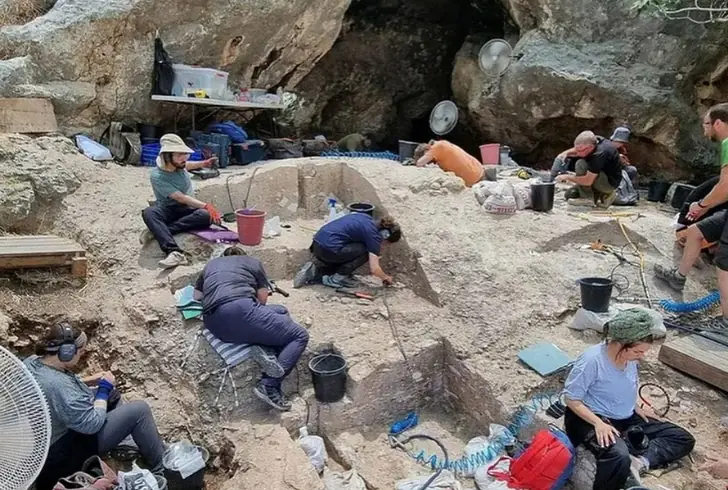
Excavations at Tinshemet Cave began in 2017 and are led by Prof. Yossi Zaidner and Dr. Marion Prévost from the Hebrew University of Jerusalem, along with Prof. Israel Hershkovitz of Tel Aviv University.
The team is working to understand how different human groups interacted during the mid-Middle Paleolithic period. Several key questions continue to guide the research:
Did these groups compete for limited resources?
Did they live side by side without conflict?
Or did they actively cooperate and shape each other’s cultures?
So far, the evidence leans toward cooperation, though the picture is still evolving.
What Brought This Culture to an End
The cultural framework associated with Tinshemet did not last forever. While the exact cause of its decline is still uncertain, environmental change is widely seen as a likely factor. Shifts in climate could have disrupted ecosystems, affecting both resources and living conditions.
At the same time, migration patterns in the region were changing. New groups entering the area may have introduced different technologies, ideas, and social structures, gradually reshaping earlier cultural systems.
Even with these changes, Tinshemet remains highly significant archaeologically. It captures a period when different human groups shared a common cultural environment.
The site suggests a world defined more by connection than separation. Homo sapiens and Neanderthals appear to have shared tools, similar hunting behaviors, and overlapping burial traditions.
This reshapes how we think about human evolution. Progress didn’t happen in isolation. It developed through interaction, shared knowledge, and cooperation.
The story of Tinshemet is not just about survival—it highlights how human relationships and cultural exchange helped shape the course of history.